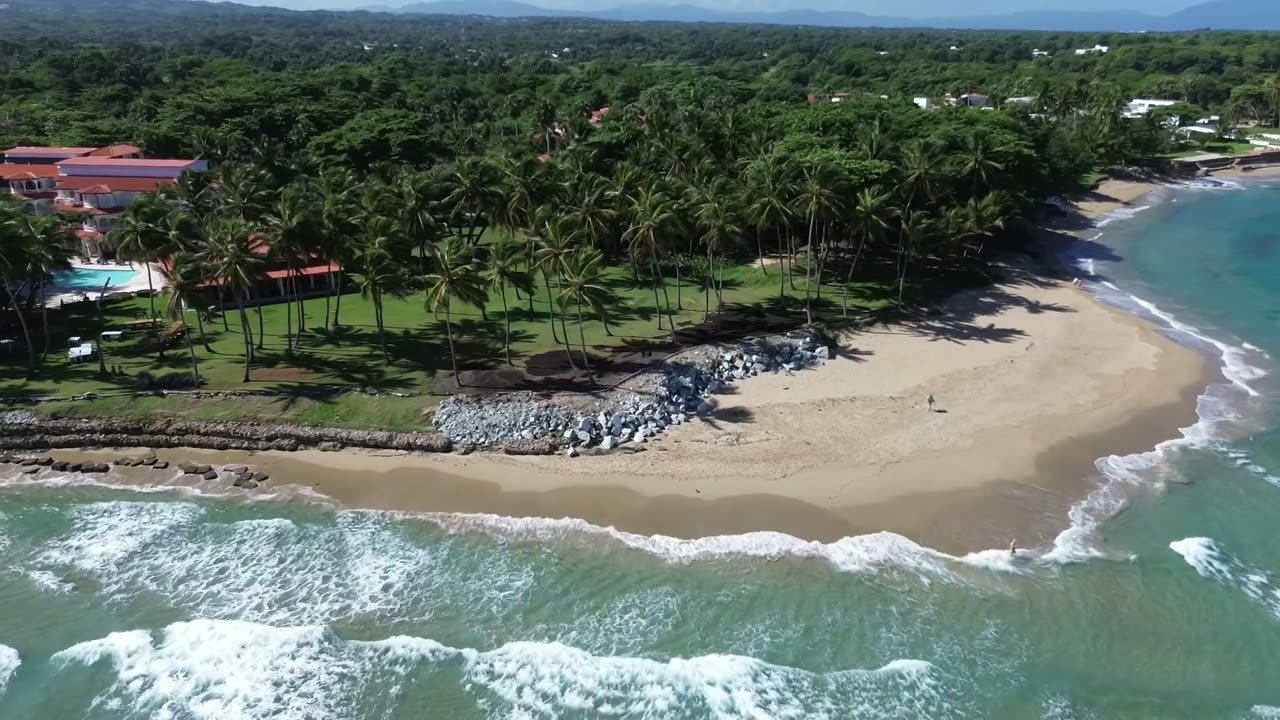
Most climate guides for the Dominican Republic are written for Punta Cana and copy one pattern: dry winter, wet summer. On the North Coast, where I live and work, it's closer to the opposite. Our heaviest rain comes from November to January, and the summer months are the driest of the year.
If you're thinking about buying or moving to Puerto Plata, Sosúa or Cabarete, that difference matters. It decides when you visit, when you build or renovate, and what to check in a property. Here are the monthly numbers, what 2026 brought, and what it's like to live with it.
Puerto Plata climate, month by month
These are 1991–2020 climate normals from the Puerto Plata weather station, based on daily observations from NOAA's global network (published by Climate-Zone). Sosúa and Cabarete are a short drive east along the same coast, so the pattern is very similar.
| Month | Avg high | Avg low | Rain |
|---|---|---|---|
| January | 29 °C | 19 °C | 173 mm |
| February | 29 °C | 19 °C | 115 mm |
| March | 30 °C | 19 °C | 150 mm |
| April | 31 °C | 20 °C | 133 mm |
| May | 32 °C | 22 °C | 111 mm |
| June | 33 °C | 23 °C | 63 mm |
| July | 33 °C | 23 °C | 75 mm |
| August | 34 °C | 23 °C | 69 mm |
| September | 33 °C | 23 °C | 88 mm |
| October | 33 °C | 22 °C | 114 mm |
| November | 31 °C | 21 °C | 225 mm |
| December | 30 °C | 20 °C | 165 mm |
Three things stand out:
The rain peaks in winter. November alone brings about 225 mm. The country's climate-change scenario report from the Ministry of Environment describes a national pattern with peaks in May and in September–October (Ministerio de Medio Ambiente). The north coast doesn't follow it, because it faces the northeast trade winds and the cold fronts that come down from North America in winter.
Summer is dry and hot. June to August get 63–75 mm a month, with highs of 33–34 °C. That's beach weather, but it's also when you feel the humidity most.
The temperature range is small. Highs move between 29 °C and 34 °C all year. Nights in January and February drop to about 19 °C, which locals call cold and visitors call perfect.
Rain here usually comes as heavy showers, not grey days. A wet November can still give you sun every morning. What it does bring is flooding in low-lying streets, which I'll get to below.
Hurricane season in 2026
The Atlantic hurricane season runs from June 1 to November 30. For the Dominican Republic, 2026 has been a quiet year:
- In its August 6 update, NOAA gave a 75% probability of a below-normal season: 7 to 13 named storms, 2 to 6 hurricanes and 0 to 2 major hurricanes (NOAA Climate Prediction Center).
- Indomet, the Dominican weather institute, also forecast activity below average, while warning that a quiet year doesn't rule out a single severe event (Listín Diario).
- By November 1, the season had ten named storms and one hurricane, Isaias, which reached Category 3 without affecting the Caribbean (Dominican Today).
The reason is El Niño. It increases wind shear over the Atlantic, which breaks storms up before they organize. Indomet notes that during moderate to strong El Niño events, only one tropical cyclone has hit the country directly (Indomet).
That's this year. Normal years are busier, and the peak months for the Dominican Republic are August to October. If you own property here, the season is a yearly checklist: shutters or impact windows, roof and drainage checked before August, and insurance that actually covers wind and water.
El Niño's other side: less rain, lower reservoirs
The same El Niño that kept hurricanes away also cut the rain. Indomet warned in May that it could bring a rainfall deficit and a higher risk of meteorological drought in the second half of 2026 (Indomet). Then it happened:
- National rainfall came in 46% below normal in May, 54.5% below in June and 45.3% below in July, according to Indomet figures reported by Listín Diario.
- The country's reservoirs went from 88.15% of capacity on May 1 (INDRHI, via Diario Libre) to 66.57% on August 21 (INDRHI, via Listín Diario).
For a property owner on the North Coast, the practical lesson is water storage. Most homes here have a cistern and a tank, and a dry year shows which ones are big enough.
Heat: the summer of 2026
On August 26, 2026, Indomet reported heat index values of 47 °C in Santo Domingo and Barahona and 44 °C in Puerto Plata, with light Saharan dust in the air (DR1). The heat index is what the body feels when humidity is added to the temperature.
The coast is cooler than the inland cities thanks to the sea breeze, but late summer is still the hardest time of year. If you're buying, cross-ventilation, ceiling fans, shade on west-facing windows and a pool aren't luxuries here. They decide how livable a house is from July to October.
Recent rain events on the North Coast
The winter rain shows up in the news every year. The two biggest events of 2026 in our province:
- January 5, 2026: a trough and a frontal system flooded sectors of Puerto Plata, Sosúa, Villa Montellano and Luperón. In Sosúa, the affected areas included Los Castillo, Sosúa Abajo and Playa Laguna; Edenorte reported a power circuit down in the Montellano area (El Atlántico).
- October 21–24, 2026: the COE raised Puerto Plata to a yellow alert because of a trough. Urban flooding was reported on the Sosúa road and in sectors such as Los Callejones and La Unión, with conditions back to normal by the next report (Diario Libre, Revista Mercado).
Neither event caused major damage, but both hit the same low-lying sectors that flood every time it rains hard. That's the most useful thing you can learn before buying: ask the neighbors, look at the street drainage, and visit the property after a heavy rain, not only on a sunny day.
Sargassum and the sea
Sea temperature on this coast stays warm all year, from about 26 °C in February to about 29 °C in September. Sargassum seaweed is a regional issue, and researchers at the University of South Florida expected 2026 to be a record year in the Caribbean (Inmobiliario.do). How much reaches a given beach changes week to week, so if it matters for a rental property, ask local managers about that specific beach.
Wind: why Cabarete exists
The same trade winds that bring the winter rain are what made Cabarete a kitesurfing and windsurfing town. They blow most of the year; kiters usually name the summer months and the December–March period as the strongest. The surf at Playa Encuentro is best in winter, when the North Atlantic swells arrive.
So when is the best time to come?
- February to April: mild temperatures, less rain than winter, humpback whale season (January to March) in Samaná Bay. The best months for a first visit.
- June to August: the driest months and the strongest summer wind, but hot.
- November to January: the rainiest stretch, with good surf. Worth one visit before you buy, to see the property and the streets around it in the rain.
If you're planning a move, I also wrote about what living in the Dominican Republic is really like from the North Coast.
Looking at Property on the North Coast?
I live in Cabarete and work with real estate agencies, developers and attorneys across the North Coast. I can't tell you how the weather will treat a specific house, but I can introduce you to people who know the area street by street.
Climate normals: Puerto Plata station, 1991–2020, NOAA station data as published by Climate-Zone. 2026 events and figures come from Indomet, NOAA, INDRHI and the COE as reported on the dates linked. Weather changes quickly; for current alerts, check indomet.gob.do and coe.gob.do.